For years, the Google Ads playbook was about control through granularity: one keyword per ad group, a campaign for every match type, a separate ad for every audience. That approach made sense when advertisers set most bids by hand. It makes far less sense now that bidding, query matching and even ad text are increasingly decided by automation.
In 2026, the job of account structure has changed. It is no longer about micromanaging the auction. It is about feeding the algorithms clean, concentrated data, and separating only the things that genuinely have different business goals.
Why granularity stopped paying off
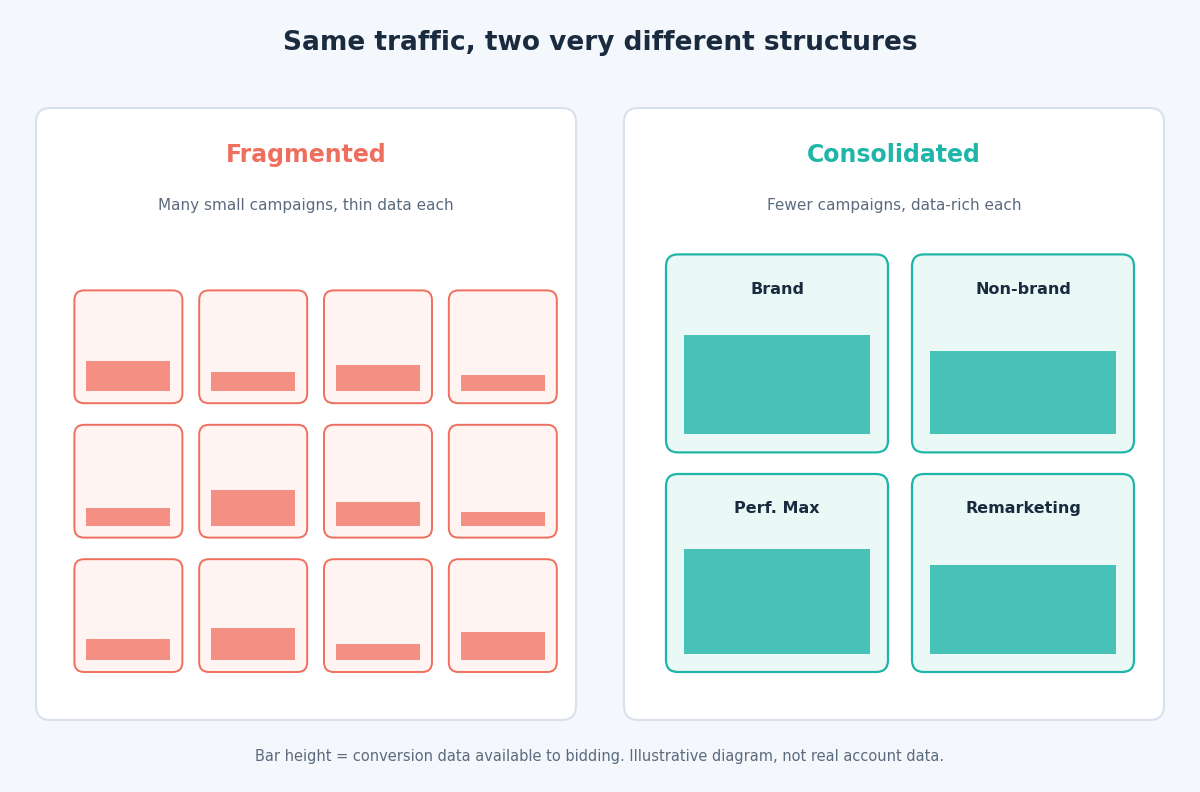
Smart Bidding learns from conversion data. Every time you split a campaign or an ad group, you divide that data into smaller pools. A campaign that records eight conversions a month gives the bidding model very little to learn from, while the same traffic merged into a single campaign might record forty.
Two other shifts weakened the case for fine-grained builds. Match types now behave more like signals than strict rules, because close variants and broad match blur the lines between them. And single-keyword ad groups, once the favorite tool for tight control, trade away scale and learning speed for a level of precision the auction no longer rewards.
The result in many audited accounts is the same: dozens of thin campaigns, each starved of data, each stuck with unstable performance.
Split only for reasons the algorithm cannot infer
A useful test before creating any new campaign is to ask: will I set a different budget, a different target, or a different message here? If the answer is no, the split is probably cosmetic.
Legitimate reasons to separate campaigns include:
- Different economics. A product with a 60% margin can support a very different target CPA or ROAS than one with a 15% margin.
- Brand versus non-brand. Brand searches convert cheaply and inflate blended results, so they deserve their own budget and reporting.
- Different goals. Lead generation and online sales should not share a bidding strategy or a conversion goal.
- Geography or language. Different markets often need different budgets, landing pages and copy.
- Budget protection. A strategic campaign that must never be starved belongs in its own budget.
Poor reasons include device, individual match types, minor keyword variations, or ad copy tests. Those are better handled inside a campaign through assets, experiments and reporting segments.
A workable blueprint for many accounts looks like this:
- Brand Search: protects your name and reports cleanly.
- Non-brand Search by theme: one campaign per service or product line, with tightly themed ad groups.
- Performance Max or Shopping: for product catalogs and cross-channel reach, with asset groups aligned to themes.
- Remarketing or Demand Gen: for re-engagement and upper-funnel audiences.
Build the measurement layer first
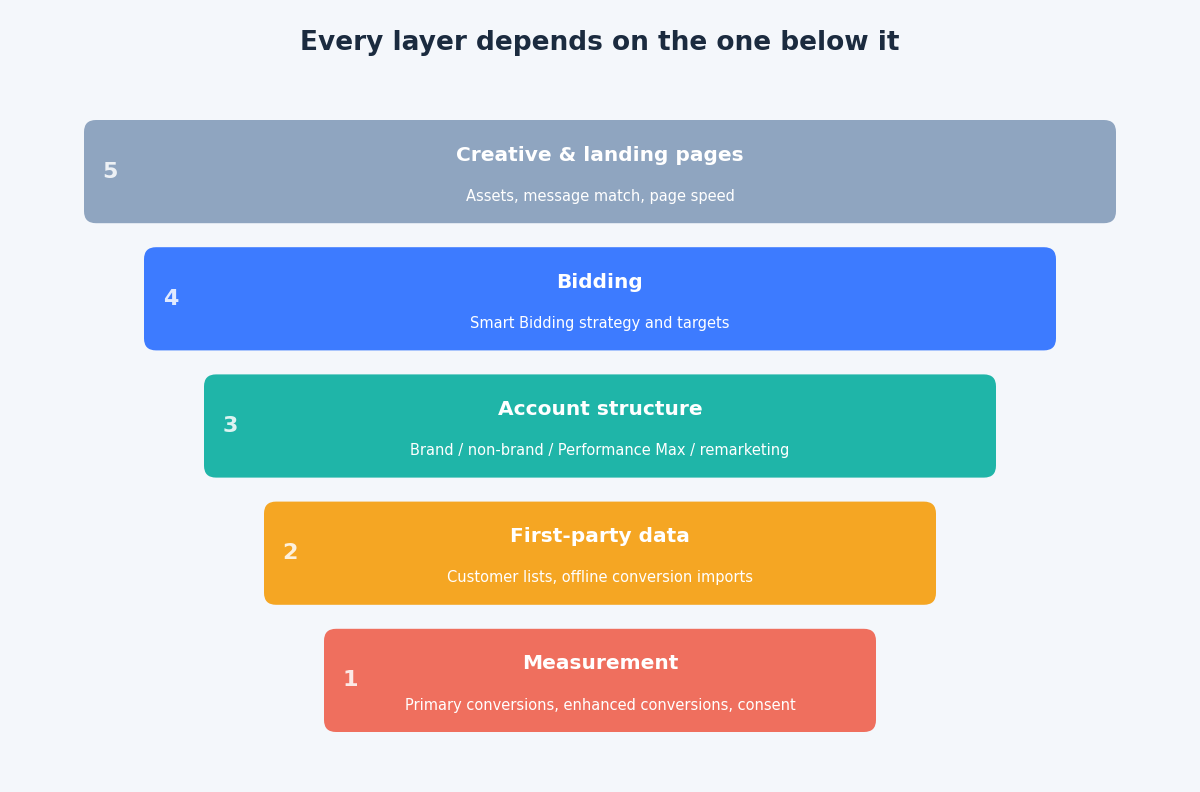
Structure is irrelevant if the underlying signal is wrong. Before you consolidate anything, make sure the conversions feeding your bidding reflect real business value.
- Choose primary conversions carefully. Only actions that represent revenue or qualified leads should be primary goals. Page views, scroll events and low-intent clicks belong in secondary goals, where they inform reporting but do not drive bidding.
- Turn on enhanced conversions. Enhanced conversions send hashed first-party data, such as email addresses from a checkout or lead form, to Google in a privacy-safe way, which improves measurement accuracy. There are versions for web conversions and for leads that later close offline.
- Import offline outcomes. If a lead becomes a customer weeks later in your CRM, send that result back. Optimizing for closed deals rather than form fills is often the single biggest quality improvement available.
- Configure consent properly. If you serve users in the European Economic Area or the UK, make sure Consent Mode is correctly implemented so measurement and audience features keep working within privacy rules.
Where AI Max and Performance Max fit
AI Max for Search is best understood as an optimization layer on top of Search campaigns rather than a separate campaign type. It combines expanded search term matching (using broad match and keywordless technology) with text customization and final URL expansion. You keep some control through brand inclusions and exclusions, locations of interest, and URL exclusions, and the search terms report shows AI Max as a match type so you can see what it is actually doing.
Google’s guidance notes that AI Max works best when campaigns are not budget-constrained, so test it on campaigns with headroom and use an experiment against your current setup rather than switching everything at once.
Performance Max suits accounts with a product catalog or a clear set of conversion goals and enough creative to feed it. Align asset groups to real themes, provide strong audience signals such as customer lists, and use brand exclusions if you need brand and non-brand results kept apart.
A 30-day restructure plan
You do not need to rebuild everything at once. A staged approach keeps risk low:
- Week 1: Audit conversion actions and fix the primary goals. Enable enhanced conversions and confirm they are recording.
- Week 2: Identify low-volume campaigns that share the same goal and economics, and plan their consolidation.
- Week 3: Merge and apply a bidding strategy that fits your data volume. Pause old campaigns rather than deleting them so history remains available.
- Week 4: Review results using a full conversion cycle as your benchmark, not a few days of data.
The takeaway
A modern Google Ads structure is a data strategy. Fewer, stronger campaigns, built on trustworthy conversion signals, give automation the best chance to work in your favor. If you would like an outside view of your account structure, get in touch through the contact page and we can walk through it together.
Related reading
- The Google Ads audit: nine expensive mistakes you can find in an hour.
- Smart Bidding targets after the August update: how to set targets that hold.
- Performance Max asset groups and audience signals: what you actually control in an automated campaign.