Most creative tests on Meta go wrong before the first impression. Five ads go into one ad set, the system sends most of the budget to one or two of them, and after three days someone declares a winner based on a handful of conversions. The “winner” is then scaled, and the results fall apart.
A test is only useful if the result changes what you do next. The framework below covers three things you should settle before launch: how the test is structured, how much it needs to spend, and which rules decide the outcome. It works for small accounts and large ones, because the logic does not depend on volume, only the numbers do.
Decide what you are actually testing
Start with a hypothesis you can write in one sentence, for example: a problem-led message will bring a lower cost per lead than a benefit-led message for this offer. Then keep everything else the same.
Test in this order, because the early layers have the biggest effect:
- Concept. The core message, angle or offer being shown.
- Format. Static image, short video, carousel, or a customer-style video.
- Details. Opening seconds, headline, call to action, colours.
Swapping one word in a headline between two otherwise identical ads rarely produces a readable result. Differences between concepts do. Before launch, ask: if this ad wins, what will we do differently? If the answer is “nothing”, it is not worth testing.
Structure the test so the comparison is fair
Keep testing separate from your main campaigns. A dedicated test campaign protects your scaling campaigns from experimental spend and makes the results easy to read.
There are three common ways to build it, each with a trade-off:
- Several ads in one ad set. Cheap and close to how ads will run for real. The problem is delivery. Meta’s auction will usually favour one or two ads early, so the others may never get a fair chance, and a low spend does not prove an ad is weak.
- One ad set per concept, with fixed budgets. Set the budget at ad set level so each concept gets guaranteed spend. Use the same audience, placements, optimisation event and attribution setting in every ad set. Keep the number of ad sets small, because ad sets aimed at the same people compete with each other and each one goes through its own learning.
- Meta’s A/B test tool. In Experiments, A/B testing splits your audience into separate groups so the same person is not exposed to both versions. It takes more setup, but it is the cleanest option when the decision matters. Meta also reports a confidence measure for results, which is a useful reminder that a difference is not the same as proof.
Size the budget from your cost per result
Work backwards from what a conversion costs. The formula is simple: budget per concept = target cost per result × the number of results you need to read the outcome.
Here is arithmetic only, not a benchmark. If your target cost per lead is 25 euros and you want around ten leads per concept before judging, each concept needs roughly 250 euros over the test. With three concepts, that is about 750 euros. If that is more than you can spend, do not shrink the test until it says nothing. Either test fewer concepts, or optimise the test for an earlier event such as add to cart, and check that the earlier event tracks the outcome you care about.
Keep the test budget to a share of the total, so your existing campaigns keep delivering while you learn.
Decide how long to run before you launch
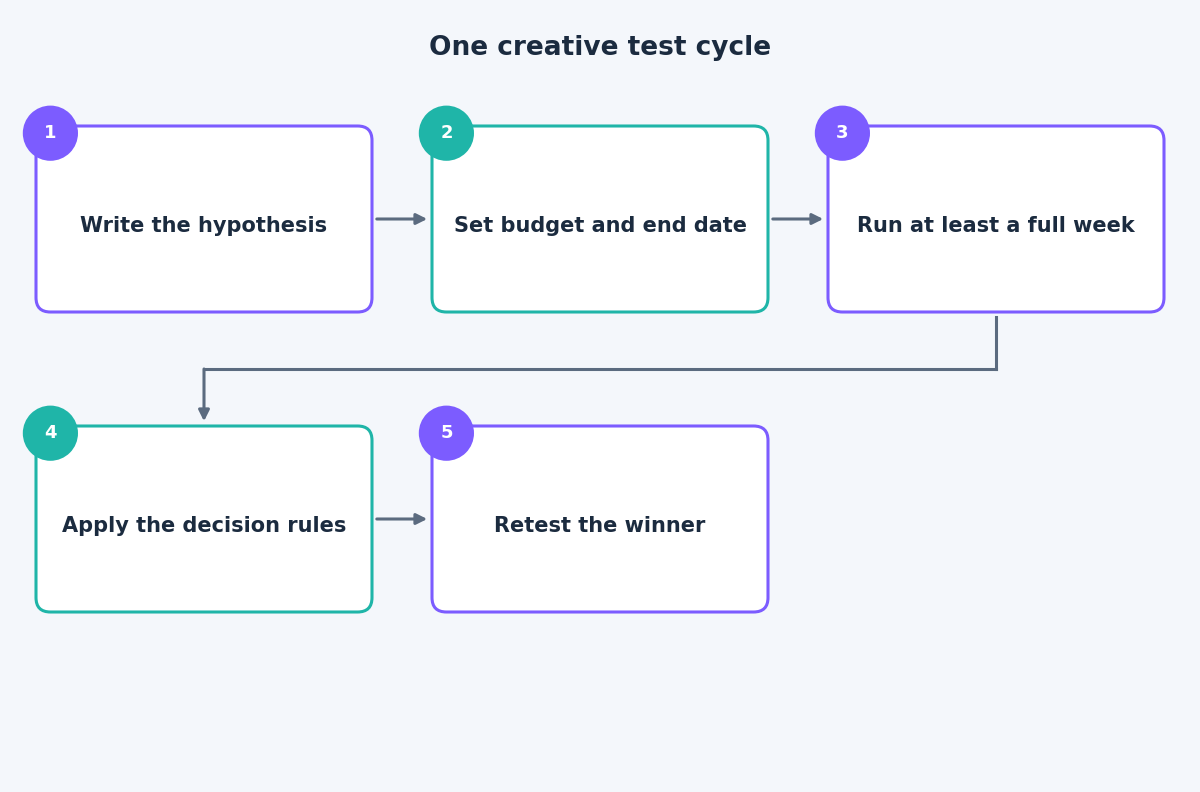
Give every test at least one full weekly cycle. Behaviour differs between weekdays and weekends, new ad sets start in a learning phase where results are less stable, and conversions are often attributed days after the click. A day-three result mostly reflects noise.
Set an end date and a spend cap in advance, and do not end the test early because one day looked good. Then write the decision rules down:
- Primary metric. Choose one, tied to money or qualified leads, such as cost per purchase or cost per lead. Click-through rate is a diagnostic, not a verdict.
- Minimum evidence. No ad is judged until it has reached the planned spend and the planned number of days.
- Kill rule. Decide the level of spend without a single result at which an ad is paused, for example a multiple of your target cost per result. This is a convention you choose, not a Meta threshold.
- Winner rule. The winner must beat the control by a margin that matters to the business. If the gap is inside the noise, call it a tie and keep the ad that is cheaper to produce.
How false winners happen
Most false winners come from the same few causes:
- Uneven delivery. One ad received most of the spend, so the comparison is not like for like.
- Small numbers. A difference of two or three conversions can reverse next week.
- Novelty. Fresh ads often look better for a short period, then settle.
- Repeated peeking. If you check every day and stop when a number looks good, you will eventually find one.
- The wrong metric. An ad that wins on clicks can lose on sales.
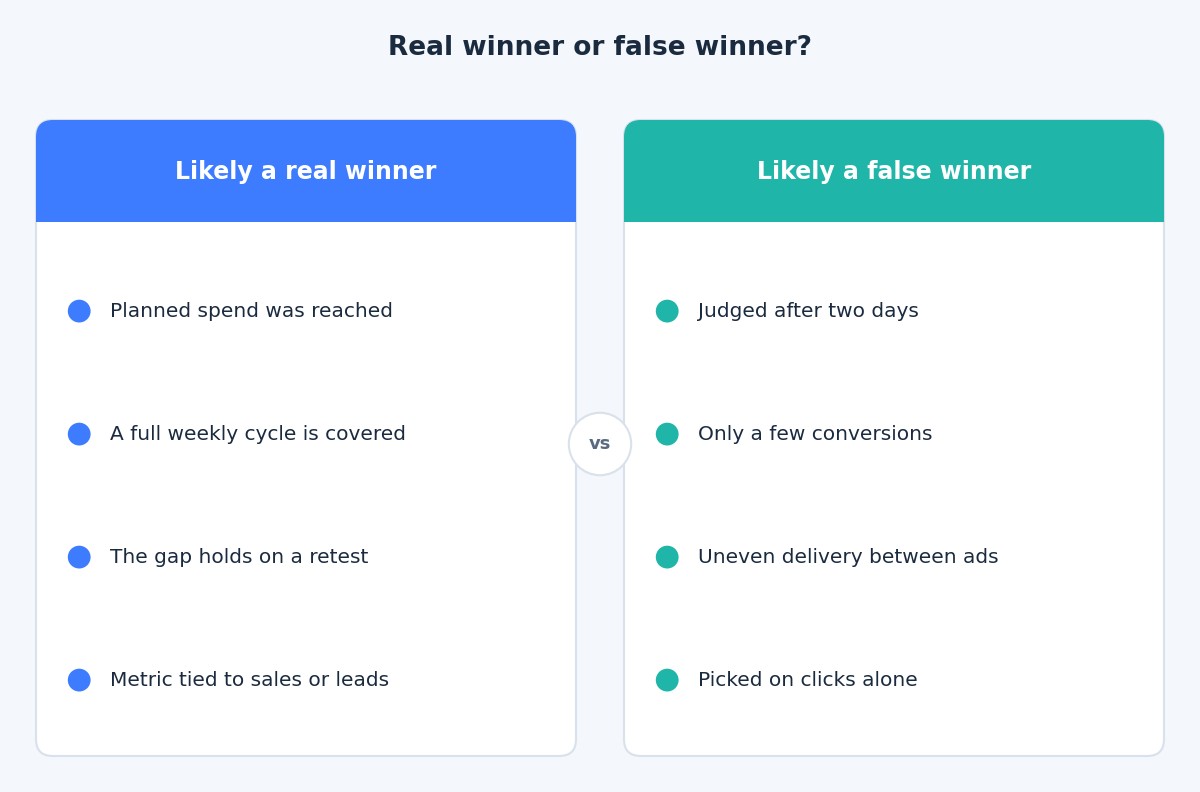
The best defence is a second round. Run the winner against the control again, then move it into your scaling campaign and watch whether the result holds. A concept that wins twice is far safer to build on than one that won once.
The takeaway
A good creative test is decided before it launches: one hypothesis, a fair structure, a budget that can produce a readable result, and rules you cannot bend afterwards. If you would like help setting up a testing structure for your account, get in touch through the contact page and we can plan it together.
Related reading
- Creative diversification on Meta: why distinct concepts beat variations.
- Advantage+ campaigns: control vs automation: what to control and what to leave to Meta.
- Scaling Meta Ads budgets: the learning phase, step sizes and what to watch.