A common creative routine on Meta goes like this: take one ad that works, then make ten versions of it with a different headline, a new background colour and a slightly shorter caption. The account now has ten ads. It still has one idea.
That distinction matters more as more of the targeting work moves into Meta’s delivery systems. This post explains what Meta has said publicly on the subject, where we are reading between the lines, and how to plan a creative mix that gives the system real choices.
What Meta has actually said
It is easy to overstate this topic, so here are the sources.
In December 2024, Meta’s engineering team published Meta Andromeda, a description of its ads retrieval system. Retrieval is the stage that narrows a very large pool of possible ads to a much smaller set that is worth ranking for a given person. Meta states that Andromeda selects from tens of millions of ad candidates down to a few thousand. The post is technical and is written about infrastructure and model performance. It does not tell advertisers how many ads to upload or how similar ads are treated.
In spring 2025 Meta’s business posts moved from the engineering side to the advertiser side. A March post on AI in ads ranking describes Andromeda as helping Meta pick the right creative from the creatives a business uploads. In April 2025, in its Advantage+ material as reported by Social Media Today, Meta said that with AI-enabled tools the focus has shifted from niche targeting to creative diversification as the best lever to find the most relevant audiences. That is a clear recommendation from Meta. It is a recommendation, not a technical specification.
What we could not find is a Meta page that documents a similarity threshold, or says that near-duplicate ads are merged or penalised. You will read confident claims about that elsewhere. Treat them as informed inference from advertisers, not as documented behaviour.
Why concepts should beat variations
With the sources in mind, here is our reading, based on how the auction works and on how accounts behave.
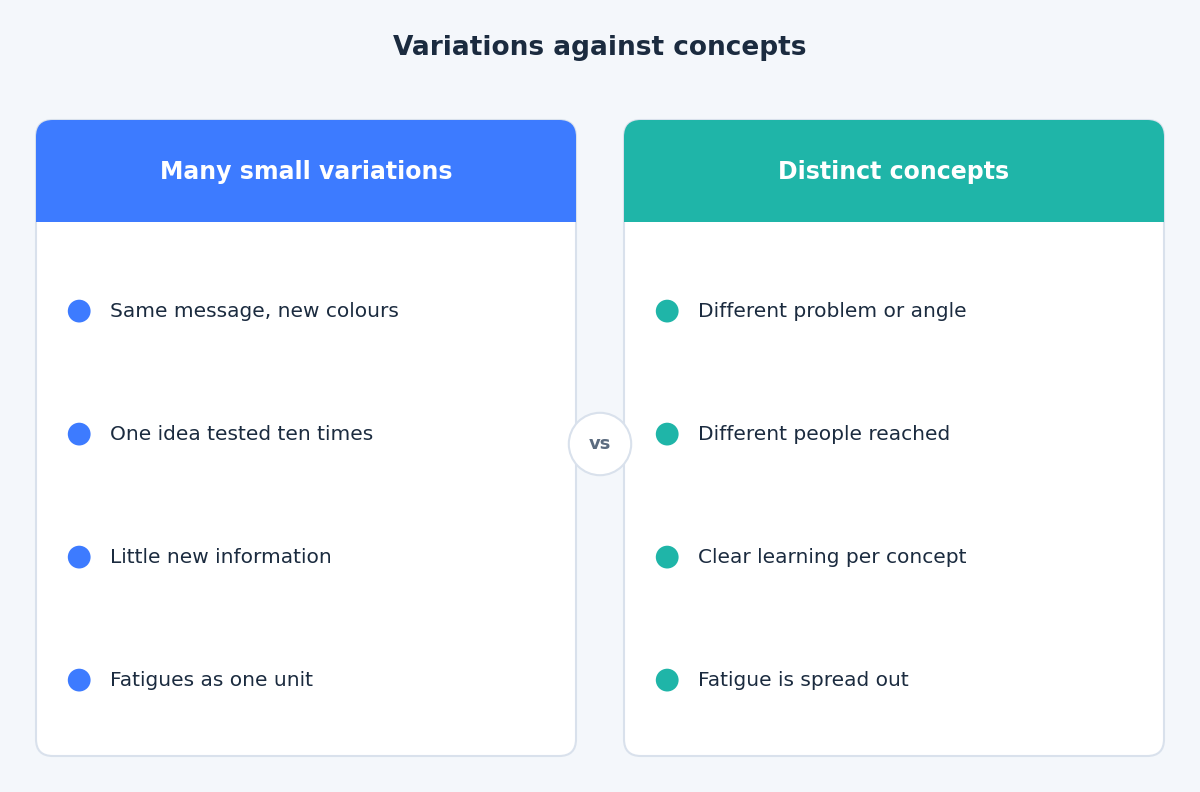
- Different concepts speak to different people. One person responds to a price argument, another to a proof point, another to a problem they recognise. When ads carry clearly different messages, delivery has more ways to match an ad to a person. Ten colour swaps of one message offer one way.
- Small variations teach you little. If two ads make the same argument, a difference in results is mostly noise. If two ads make different arguments, a difference tells you something you can use.
- Variations split the budget without adding information. Every extra ad takes a share of spend and impressions. Spending it on near-identical ads is a poor use of a limited budget.
- Fatigue happens at concept level. When people have seen an idea often enough, replacing the headline rarely brings the response back. A new idea does.
Automated enhancements do not solve this either. They can produce versions of an asset you provide, but versions of one asset are still one concept.
Build differences into the brief
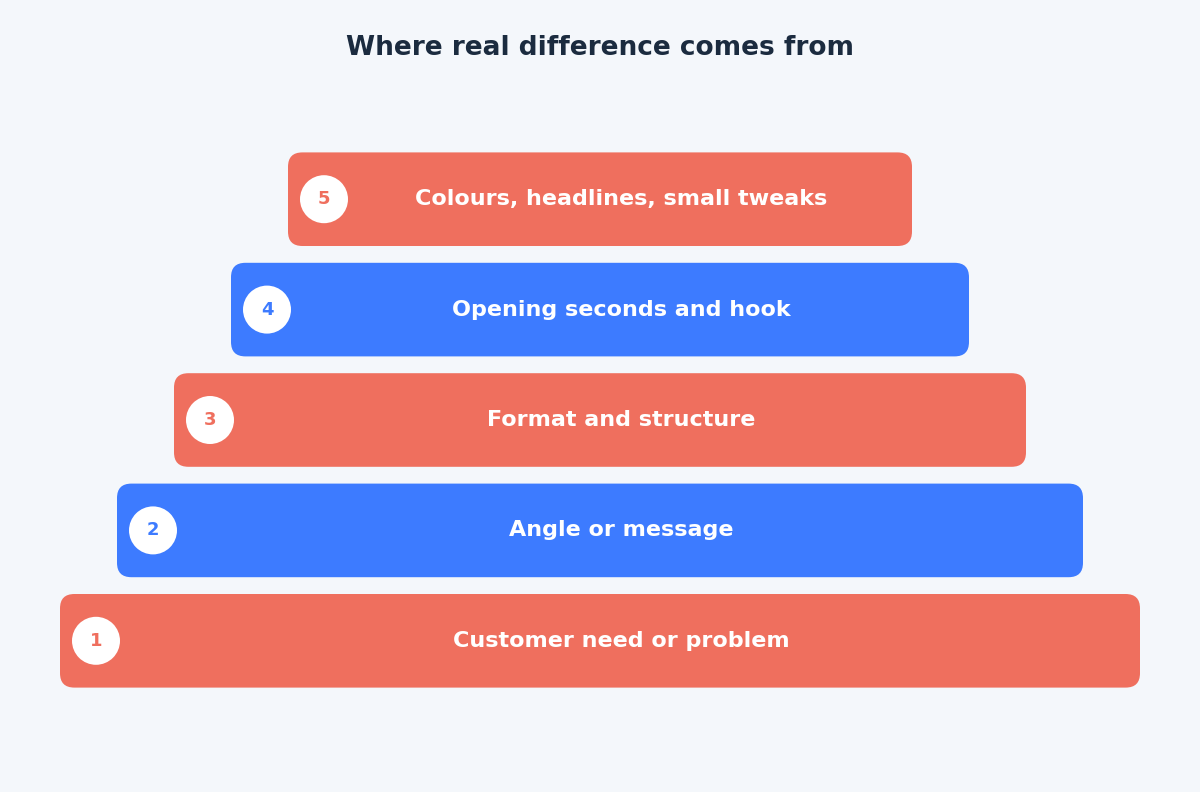
Diversity does not happen by accident. Write the differences into the brief before anyone opens a design tool. Concepts can differ on any of these:
- The problem or need. Save time, save money, reduce risk, look better, feel better.
- The angle. Problem-led, benefit-led, social proof, comparison, education, offer.
- The person. Different buyers, or the same buyer at a different moment.
- The format. Short video, static image, carousel, customer-style video, product demo.
- The opening. The first seconds of a video or the first line on screen.
A good working test: if you removed the logo and the text, would two ads still look and feel different? If not, they are variations.
A practical plan for the next round
- Audit what you run. Group your current ads by concept, not by file. Count concepts. Many accounts find they have two or three ideas spread across dozens of ads.
- Plan a small set of distinct concepts. For most budgets, three to five is a workable range. This is our own working number, not a Meta requirement. A smaller budget should mean fewer concepts, not thinner ones.
- Name ads by concept. Add a concept tag to every ad name so you can report at concept level rather than ad level.
- Judge concepts, not single ads. Look at cost per result across all ads in a concept, over enough time and spend to be fair.
- Iterate inside winners. Once a concept proves itself, variations become useful: they polish something that already works. Use diversity to find ideas and variations to refine them.
Keep the mix healthy over time
Watch for signs that a concept is wearing out: rising frequency, rising cost per result, and falling click-through, especially when the audience is stable. When that happens, add a new concept rather than another tweak. Keep an eye on production as well. A steady flow of one or two new concepts a month beats a big burst followed by months of silence.
The takeaway
Meta has said that creative diversification is now the best lever for finding relevant audiences, and that fits what its delivery systems are described as doing: choosing between a large number of candidate ads. Give it distinct ideas, measure at concept level, and use variations only to refine what has already won. If you would like a review of your current creative mix, get in touch through the contact page and we can look at it together.
Related reading
- A creative testing framework for Meta Ads: how to test creative without picking false winners.
- Advantage+ campaigns: control vs automation: what to control and what to leave to Meta.
- Scaling Meta Ads budgets: the learning phase, step sizes and what to watch.