Meta has spent the last few years moving more decisions from the advertiser to its own systems, and the direction is clear in Ads Manager. In February 2025, as reported by Search Engine Land, Meta announced a simplified Advantage+ setup that applies its automation to sales, app and leads campaigns, with the changes coming to Ads Manager through 2025.
That leaves advertisers with a practical question. Not “manual or automated?”, but “which decisions are still ours?” This post separates the inputs you should keep control of from the delivery decisions that automation usually handles better than a person can.
First, check what your account actually shows
Rollouts on Meta are gradual, and accounts do not all change on the same day. Depending on your account, you may still see the earlier Advantage+ shopping and app campaign types, or the simplified setup that Meta described in February. Trade press coverage from February and March, for example from Jon Loomer, said Advantage+ sales would replace Advantage+ shopping, bring back ad sets, and drop the existing customer budget cap.
We have not seen Meta publish a full, dated description of the final campaign structure yet, so this article avoids relying on exact menu names. The principles below hold whichever version you have.
What to control
Automation optimises toward what you give it. These inputs are yours:
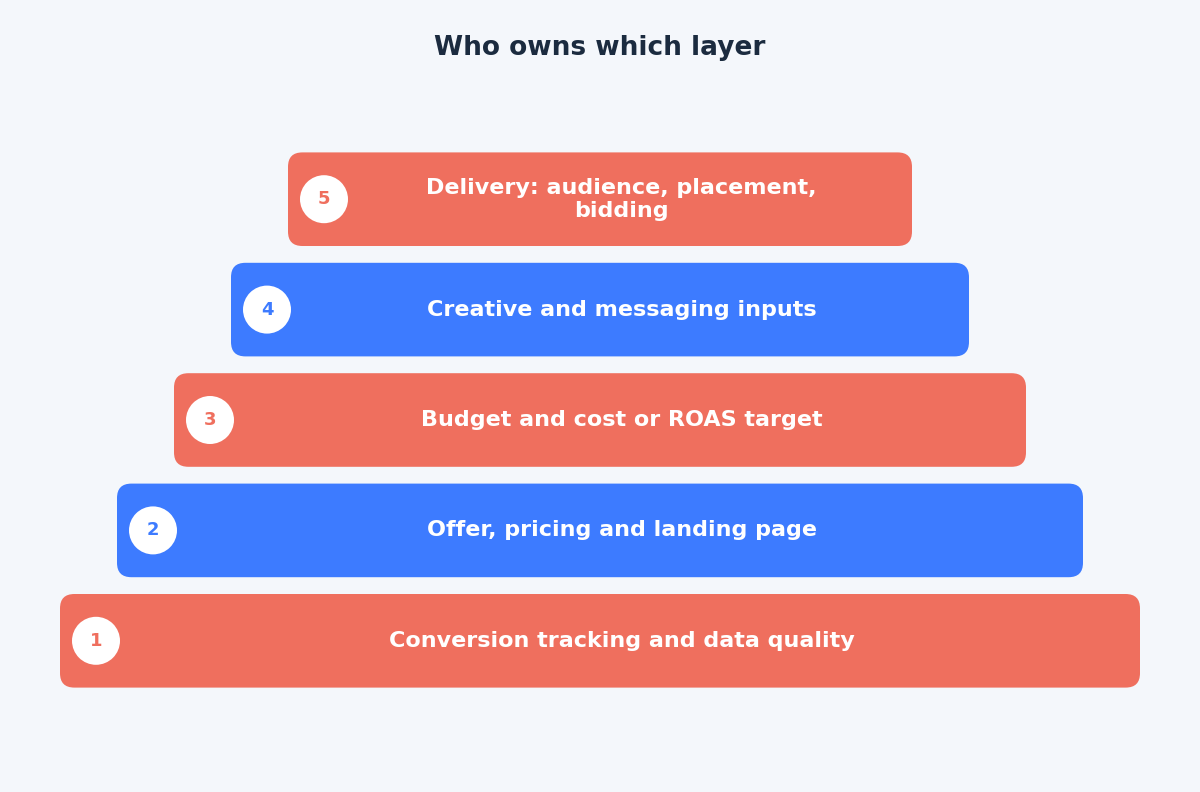
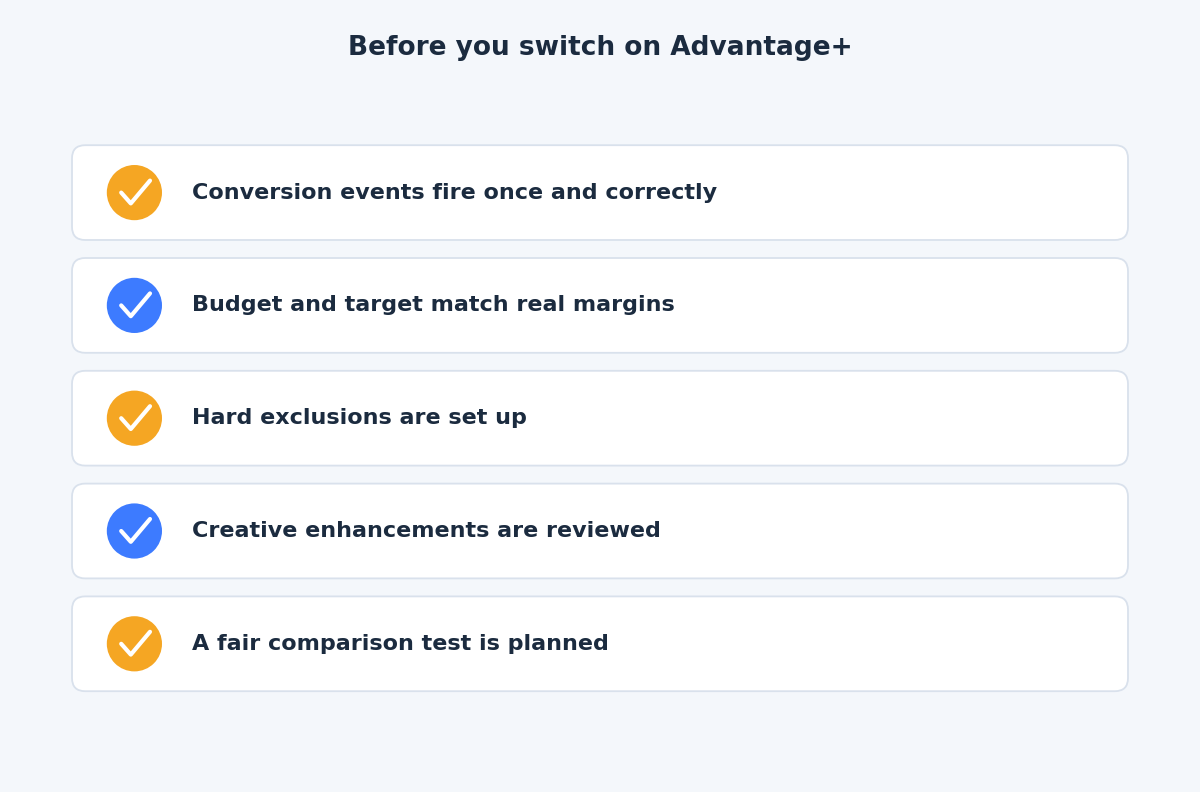
- The conversion signal. Advantage+ can only chase the event you send. Check that the event is the one that matters (purchase or qualified lead, not page view), that it fires once, and that value is passed correctly. A weak signal is amplified by automation, not fixed by it.
- Budget and target. Meta will not know your margins. Set the budget, and any cost or return goal, from your economics rather than from habit.
- The offer and the landing page. No delivery system can rescue a page that does not convert. Message match and page speed still sit with you.
- Hard exclusions. Location, language and minimum age are business rules, not signals. If you want to focus on new customers, use exclusions and reporting to check it rather than assuming it, particularly if the existing customer cap is no longer there.
- Brand and creative guardrails. Decide what your ads may say and show. Review which creative enhancements are switched on, because they can be enabled or disabled individually, and turn off any that change your message or brand in ways you would not approve by hand.
What to leave to automation
Once the inputs are sound, some decisions are better handed over:
- Audience discovery. Meta’s Advantage+ audience treats your interests and demographics as suggestions rather than fixed limits. Narrow hand-built segments rarely beat a system that can see far more signals than you can.
- Placements. Letting delivery move between Feed, Stories, Reels and other placements avoids paying more to stay inside a placement list you guessed at.
- Budget distribution. If you run several ad sets, let the system move spend to where results are cheaper, rather than adjusting it by hand every morning.
- Creative selection. Give it several distinct ads and let it decide which one goes to which person.
Meta’s own Advantage+ overview puts the emphasis on creative in this model. That matches what we see in practice: as targeting becomes less manual, the ad itself does more of the work of finding the right people.
Give the system something to choose from
When targeting loosens, creative becomes your most useful day-to-day lever. Supply several distinct ads rather than one ad cut into five sizes: different messages, different formats and different opening seconds. Check that each asset works in vertical and square formats, because delivery will place it wherever it performs. Then refresh on a schedule, and retire ads when their results decline instead of waiting until the account looks tired.
Where automation needs a guard
Handing over delivery does not mean handing over judgement. Watch for these:
- Blended results. Strong overall numbers can hide a shift toward existing customers or cheap, low-value conversions. Look at results by new versus existing customers where the reporting allows, and at value rather than count.
- Quality of leads. For lead generation, the system will find more people who behave like the leads you have already recorded. If every form fill looks the same to it, it may optimise for the cheapest one.
- Attribution. More automation can make it harder to see what caused a sale. Compare against a holdout or a fair test, not only against platform-reported results.
Test it fairly instead of switching everything
Do not move a whole account on faith. Run an Advantage+ campaign alongside your current setup, with comparable budgets and the same conversion goal. Judge both on the business result you care about, over a full conversion cycle, and change one thing at a time.
If the automated version wins, move more budget across in steps. If it loses, look at your inputs first. In most cases the fix is a better conversion signal or more varied creative, not a return to narrow manual targeting.
The takeaway
Keep control of what Meta cannot know: your goal, your margins, your offer and your rules. Let it handle what it can see better than you can: who to show the ad to, where, and when. If you would like a second opinion on how your account is set up, reach out through the contact page and we can review it together.
Related reading
- Creative diversification on Meta: why distinct concepts beat variations.
- A creative testing framework for Meta Ads: how to test creative without picking false winners.
- Scaling Meta Ads budgets: the learning phase, step sizes and what to watch.